 Add to Chrome
 Add to Firefox
 Add to Edge
SparseOpt: Addressing Normalization-induced Gradient Skew in Sparse Training
May 26, 2026
Dynamic Sparse Training (DST) methods train neural networks by maintaining sparsity while dynamically adapting the network topology. Despite the promise of reduced computation, DST methods converge significantly slower than dense training, often requiring comparable training time to achieve similar accuracy. We demonstrate both analytically and empirically that Batch Normalization (BN) adversely affects sparse training, and propose SparseOpt, a sparsity-aware optimizer, to address this. Experiments on ResNet models across CIFAR-100 and ImageNet demonstrate consistently faster convergence and improved generalization with our proposed method. Our work highlights the limitations of current normalization layers in sparse training and provides the first systematic study of the interaction between Batch Normalization, sparse layers, and DST, taking a significant step toward making DST practically competitive with dense training.

HORST: Composing Optimizer Geometries for Sparse Transformer Training
May 20, 2026Sparsifying transformers remains a fundamental challenge, as standard optimizers fail to simultaneously encourage sparsity and maintain training stability. Effective adaptive optimizers exhibit an implicit $L_{\infty}$ bias favoring stability, yet, sparsity requires an $L_1$ bias. To integrate sparsity, we propose a composition of optimizer steps, which we cast as non-commutative operators to analyze and combine their optimization geometry in a principled way. This yields HORST (Hyperbolic Operator for Robust Sparse Training), a modular optimizer that inherits stability from adaptive methods while inducing $L_1$ sparsity bias through a hyperbolic mirror map. Our experiments demonstrate its utility for sparse training of transformers on both vision and language tasks. HORST consistently and significantly outperforms AdamW baselines across all sparsity levels, with large gains at higher sparsity.
Implicit Bias of Mirror Flow in Homogeneous Neural Networks: Sparse and Dense Feature Learning
May 19, 2026We study the max-margin solutions reached by mirror flow in deep neural networks with homogeneous activation functions. Extending classical results on gradient flow, we derive a novel balance equation for mirror flow from convex duality, enabling a characterization of the horizon function governing the induced margin. We further establish max-margin characterizations together with convergence rates and norm growth estimates. Finally, we support our theory through experiments on synthetic datasets and standard vision tasks. Concretely, we show that: (1) distinct non-homogeneous mirror maps can induce the same max-margin solution; (2) convergence can be extremely slow, including exponentially slow regimes; and (3) although all considered mirror maps exhibit feature learning, they can produce markedly different representations, ranging from sparse to dense neuron activations. Together, these results provide a unified perspective on sparse and dense feature learning in homogeneous neural networks, highlighting how mirror maps shape both optimization dynamics and the geometry of the learned classifiers.
Never Saddle for Reparameterized Steepest Descent as Mirror Flow
Mar 02, 2026How does the choice of optimization algorithm shape a model's ability to learn features? To address this question for steepest descent methods --including sign descent, which is closely related to Adam --we introduce steepest mirror flows as a unifying theoretical framework. This framework reveals how optimization geometry governs learning dynamics, implicit bias, and sparsity and it provides two explanations for why Adam and AdamW often outperform SGD in fine-tuning. Focusing on diagonal linear networks and deep diagonal linear reparameterizations (a simplified proxy for attention), we show that steeper descent facilitates both saddle-point escape and feature learning. In contrast, gradient descent requires unrealistically large learning rates to escape saddles, an uncommon regime in fine-tuning. Empirically, we confirm that saddle-point escape is a central challenge in fine-tuning. Furthermore, we demonstrate that decoupled weight decay, as in AdamW, stabilizes feature learning by enforcing novel balance equations. Together, these results highlight two mechanisms how steepest descent can aid modern optimization.
Pay Attention to Small Weights
Jun 26, 2025Finetuning large pretrained neural networks is known to be resource-intensive, both in terms of memory and computational cost. To mitigate this, a common approach is to restrict training to a subset of the model parameters. By analyzing the relationship between gradients and weights during finetuning, we observe a notable pattern: large gradients are often associated with small-magnitude weights. This correlation is more pronounced in finetuning settings than in training from scratch. Motivated by this observation, we propose NANOADAM, which dynamically updates only the small-magnitude weights during finetuning and offers several practical advantages: first, this criterion is gradient-free -- the parameter subset can be determined without gradient computation; second, it preserves large-magnitude weights, which are likely to encode critical features learned during pretraining, thereby reducing the risk of catastrophic forgetting; thirdly, it permits the use of larger learning rates and consistently leads to better generalization performance in experiments. We demonstrate this for both NLP and vision tasks.
Sign-In to the Lottery: Reparameterizing Sparse Training From Scratch
Apr 17, 2025The performance gap between training sparse neural networks from scratch (PaI) and dense-to-sparse training presents a major roadblock for efficient deep learning. According to the Lottery Ticket Hypothesis, PaI hinges on finding a problem specific parameter initialization. As we show, to this end, determining correct parameter signs is sufficient. Yet, they remain elusive to PaI. To address this issue, we propose Sign-In, which employs a dynamic reparameterization that provably induces sign flips. Such sign flips are complementary to the ones that dense-to-sparse training can accomplish, rendering Sign-In as an orthogonal method. While our experiments and theory suggest performance improvements of PaI, they also carve out the main open challenge to close the gap between PaI and dense-to-sparse training.
Mirror, Mirror of the Flow: How Does Regularization Shape Implicit Bias?
Apr 17, 2025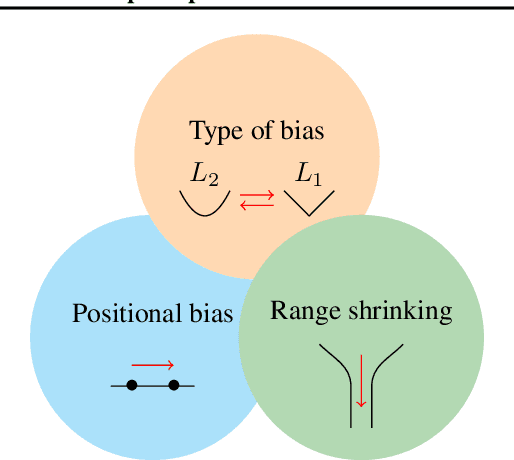
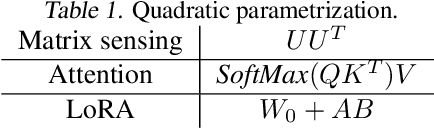
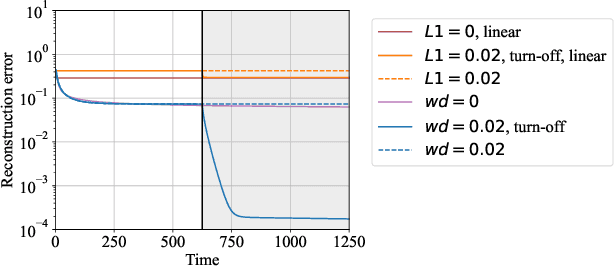
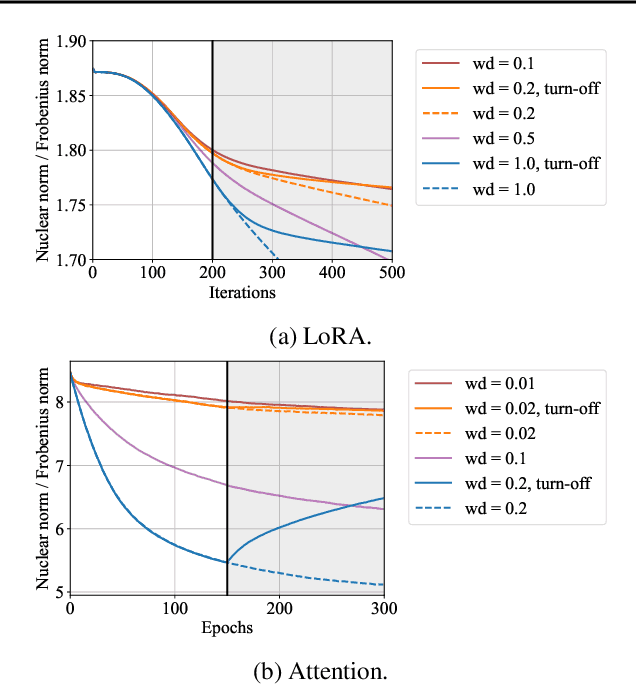
Implicit bias plays an important role in explaining how overparameterized models generalize well. Explicit regularization like weight decay is often employed in addition to prevent overfitting. While both concepts have been studied separately, in practice, they often act in tandem. Understanding their interplay is key to controlling the shape and strength of implicit bias, as it can be modified by explicit regularization. To this end, we incorporate explicit regularization into the mirror flow framework and analyze its lasting effects on the geometry of the training dynamics, covering three distinct effects: positional bias, type of bias, and range shrinking. Our analytical approach encompasses a broad class of problems, including sparse coding, matrix sensing, single-layer attention, and LoRA, for which we demonstrate the utility of our insights. To exploit the lasting effect of regularization and highlight the potential benefit of dynamic weight decay schedules, we propose to switch off weight decay during training, which can improve generalization, as we demonstrate in experiments.
Mask in the Mirror: Implicit Sparsification
Aug 19, 2024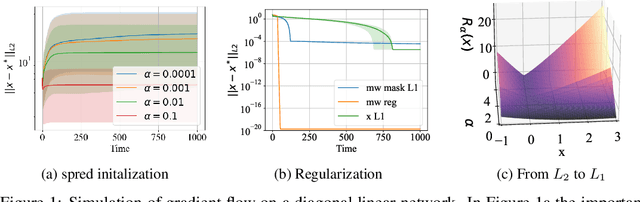
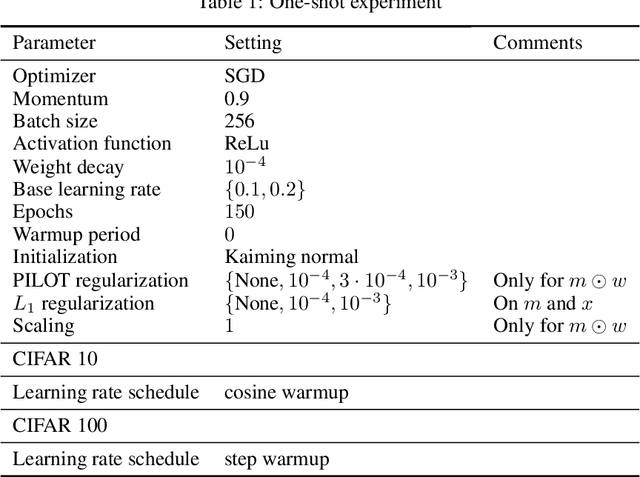
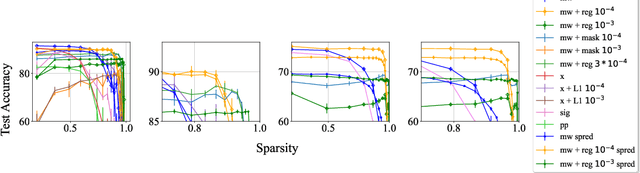
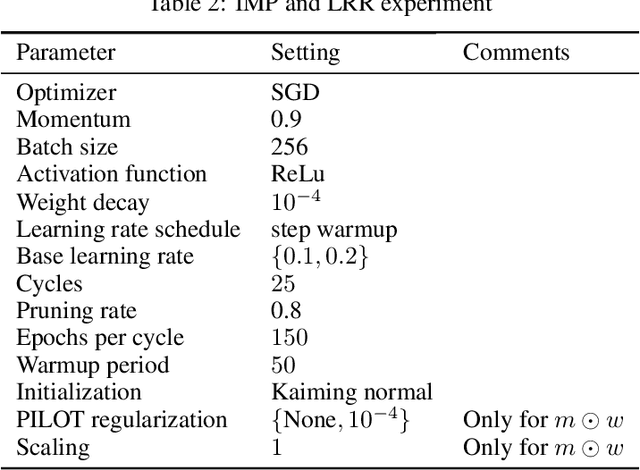
Sparsifying deep neural networks to reduce their inference cost is an NP-hard problem and difficult to optimize due to its mixed discrete and continuous nature. Yet, as we prove, continuous sparsification has already an implicit bias towards sparsity that would not require common projections of relaxed mask variables. While implicit rather than explicit regularization induces benefits, it usually does not provide enough flexibility in practice, as only a specific target sparsity is obtainable. To exploit its potential for continuous sparsification, we propose a way to control the strength of the implicit bias. Based on the mirror flow framework, we derive resulting convergence and optimality guarantees in the context of underdetermined linear regression and demonstrate the utility of our insights in more general neural network sparsification experiments, achieving significant performance gains, particularly in the high-sparsity regime. Our theoretical contribution might be of independent interest, as we highlight a way to enter the rich regime and show that implicit bias is controllable by a time-dependent Bregman potential.